





Written by Perry Bickel
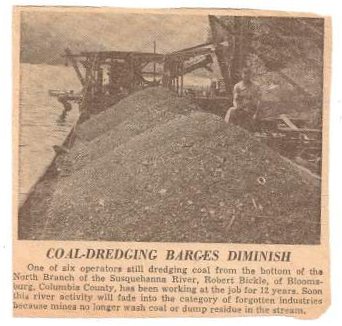
When viewed from a geological perspective, it can be said that the last half century of American history represents an evolving trade-off between the nation's need for energy and the gradually increasing need for sustainable environmental standards that will enable the human race to continue to flourish while, at the same time, doing so "with the lights on." The coal dredging era represented a brief though beneficial period during which the effort to utilize so-called waste coal for energy generation was viewed as representing a progressive win-win period in which one man's waste was turned into another man's profits.
Most recently the "pendulum" has swung far in the direction of viewing coal burning of any kind as representing the ultimate villain, the source of all of man's environmental problems including acid rain and global warming. The disdain for coal has reached the point that it is difficult to visualize it having a significant role in meeting the country's future energy needs. The United States may represent the World's "Saudi Arabia of Coal," but this claim seems to be met more today by embarrassment than with pride.
In this context, coal is no longer viewed as being a mixed blessing; it is now viewed largely as being a curse. Legislation has replaced this more moderate and economically motivated example of dealing with one of society's issues, waste coal. Laws have now become the exclusive rededy for dealing with coal. No moderate middle-of-the-road perspective is accepted.
A plethora of laws has impacted the coal industry, many of them focusing on increasing standards for air quality. The United States Federal Government enacted a series of clean air acts beginning with the Air Pollution Control Act of 1955 and followed by the Clean Air Act of 1963, the Air Quality Act of 1967, the Clean Air Act of Extension of 1970, and Clean Air Act Amendments in 1977 and 1990. Numerous state and local governments have enacted similar legislation, either implementing federal programs or filling in locally important gaps in federal programs.
As long as coal is viewed as being a primary source of the world's pollution, it will remain the target of pollution related laws. Laws will thus remain the exclusive remedy for dealing with these issues. If technological advances are eventually able to decrease the level of pollutants associated with coal burning, a return to a more economically based, win-win model may one day again be feasible. The days of dredging coal "waste" form rivers are probably gone forever, but there are other sources of land-based refuse coal that can serve a similar purpose in the future if technology is able to pave the way for this to happen. This newest chapter of the coal "waste" story has yet to be written.